Does AI help you sleep better?
 Photo: VinzentWeinbeer via Pixabay
The short answer. For most people, AI does not fix bad sleep. The problem is usually behavioural rather than medical, and the evidence backs dull, free fixes: morning light, a fixed wake time, and some friction between you and your phone at night. AI helps here only as a blunt nudge.
I went looking for an AI fix for my own sleep and did not find one. My problem was never insomnia, that is my mum's battle. Mine is a decision I keep making at midnight with a phone in my hand. What shifted it for me was dull and free... an earlier alarm, a book where the scroll used to be, and a nudge said out loud so it lived outside my head.
Is your sleep problem medical or behavioural?
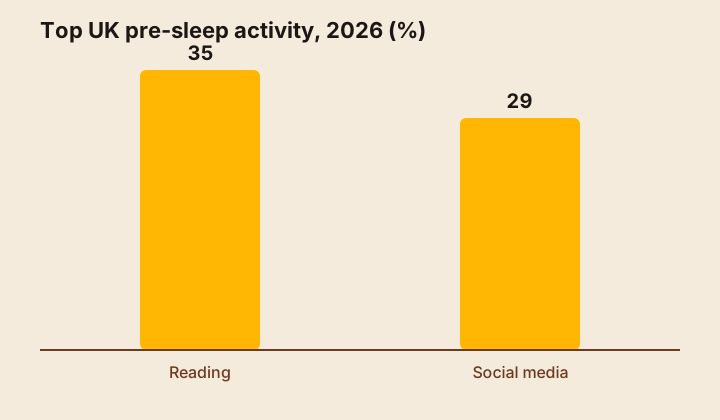
Most of the time it is behavioural, and that changes everything about the fix. There is a real clinical problem out there. The Sleep Charity estimates 14 million UK adults have undiagnosed insomnia, and only about one in six people with symptoms have ever been diagnosed (The Sleep Charity, 2024). That is your body keeping you awake, and it needs proper help. But for a lot of us the issue is simpler and more annoying: we choose to stay up. The UK now averages 6.4 hours a night, and reading has overtaken scrolling as the most common pre-sleep activity, 35% to 29% (Dreams 2026 UK Sleep Survey).
Work out which camp you are in first, because AI has nothing to offer the medical one and only a bit-part in the other.
Will an AI app fix a late bedtime?
Mostly no, and the strongest evidence for a fix that works contains no AI at all. The one sec app put a one-second pause between people and their chosen apps. Opens fell 37% across a six-week study, and 36% of attempts were abandoned at the pause (PNAS, 2023). That is a speed bump, and there is no intelligence in it. The most AI-flavoured tools, wearable sleep trackers, carry a documented way of backfiring called orthosomnia, a term coined by Baron and colleagues in 2017, where anxiety about the numbers makes sleep worse. It affects an estimated 3 to 14% of adults (Brain Sciences, 2024). If you are a data person, a tracker is as likely to be a trap as a tool.
 Photo: congerdesign via Pixabay
How do you turn a night owl into an early riser?
You move your wake time and your morning light, and the bedtime follows. In a study from Birmingham, Surrey and Monash, 22 night owls advanced their body clock by two hours in three weeks. The routine: outdoor light on waking, fixed meal times with no dinner after 7pm, and one wake time held every day including weekends. No medication, no lost sleep, and they finished with better morning reaction time and grip strength and lower stress (Sleep Medicine, 2019). Set the alarm earlier and your body starts asking to go to bed earlier on its own.
And if your brain runs late, that is not a character flaw. Delayed sleep timing shows up in up to 78% of people with ADHD, with adult melatonin onset about 90 minutes behind (Frontiers in Psychiatry, 2025). The routine still works, it only asks more of you to hold the line.
The idea that modern life wrecked everyone's sleep does not hold up. UK sleep rose about 43 minutes between 1974 and 2015 (Journal of Sleep Research, 2019). The struggle is real, but it is personal and behavioural. Modern life did not curse the lot of us at once.
What works, in order
- Get outdoor light within an hour of waking. The single strongest signal for shifting your clock earlier (Sleep Medicine, 2019).
- Pick one wake time and hold it, weekends included. The rule that drives the whole shift.
- Stop eating by 7pm. Late food delays the clock (Sleep Medicine, 2019).
- Put friction on the phone at night. A one-second barrier cut app opens 37% (PNAS, 2023).
- Swap the scroll for a book. The country already is: reading is now the top pre-sleep habit (Dreams, 2026).
Where does AI earn its place?
In two small, honest jobs, and the build I run leans on both. It is a chain of friction. No single app does this. Wind-down starts with a Focus mode that dims the screen and drops notifications. Then my dashboard nudges me that bedtime is coming. Then I physically tap a Brick, an NFC lock, and the phone is gone for the night, with my glucose monitor the one thing left allowlisted, because I am Type 1 and that is non-negotiable. The alarm is 5:30, and it does not open on the first tap either, an app makes me do the press-ups first (a brutal way to meet the day). Then, on the days I do not have the kids, a walk before the day has started. None of it is unbreakable. I still have to choose to break each link instead of drifting into the scroll on autopilot. AI's honest job in all of it is small, the warning and the encouragement, a dashboard that says "you got seven hours last night, nice job, you used to get six", so the promise I made to myself lives somewhere I have to answer to. Taken out of your head, a thing is more likely to happen.
 Photo: congerdesign via Pixabay
The builds
Four things came out of this week, all free.
The nuclear sleep solution, evening lock-down and morning routine in one, is the main one. Get the BOARD guide and I'll send you the lot.
The Owl-Shift Checklist is the three-week circadian routine, on a habit grid you tick each day. It covers morning light, a fixed wake time, and no food after seven. Get the OWL guide.
The Accountability Nudge is a phone Shortcut that logs your lights-out time. A weekly automation sends you a streak score, or pings a mate to keep you honest. Get the NUDGE guide.
Then the long list. I found 156 sleep fixes and put every one on a page you filter, each with its cost, an evidence grade and a source. It runs in two lanes, behavioural and clinical, and my five picks sit pinned at the front. Get the SLEEP SOLUTIONS directory.
The verdict
Can AI fix your sleep? No. But it will hold the door while you fix it yourself. The real work is a wake time you refuse to move and a phone that is out of reach after half ten, and both of those cost nothing.
Frequently asked questions
Does AI fix insomnia? Not meaningfully. Clinical insomnia is medical, and the front-line treatment is CBT-I, the talking therapy your GP will point you to. If sleep won't come even when you get to bed on time, start there.
What is the best AI app to fix my sleep? For most people the best tools are the free ones you already own. Screen Time blocks apps at bedtime, and a fixed alarm beats most paid circadian apps. RISE tracks your sleep debt and energy, and Timeshifter is built for jet lag and shift work, around $70 a year each, and neither is designed to teach habitual early rising.
Are sleep trackers worth it? They help a little, but watching the data too closely causes orthosomnia, where the worry makes sleep worse. Use one for a fortnight to learn your pattern, then put it away.
How long does it take to become a morning person? About three weeks of a fixed wake time, morning light and an early food cutoff, based on the Birmingham, Surrey and Monash study.
Why do I stay up late even when I'm tired? Usually it is a habit loop, not a sleep disorder. The evening feels like the only time that is yours, and the phone makes it easy to keep taking more of it. Friction breaks the loop.
Does eating late affect sleep? Yes. The night-owl study used a no-dinner-after-7pm rule as part of the routine that moved bedtimes two hours earlier.
Sources: The Sleep Charity (2024); Dreams 2026 UK Sleep Survey, OnePoll; one sec, PNAS (2023); orthosomnia, Brain Sciences (2024); night-owl retraining, Sleep Medicine (2019); ADHD sleep timing, Frontiers in Psychiatry (2025); historical sleep trends, Journal of Sleep Research (2019).
Want this working in your business?
I train teams to use AI, then build what they need. Half an hour on where it fits yours, with no pitch attached.
Book a call